The lectures “Mobile Communications” and “Wireless Networks” give a comprehensive introduction to mobile communication systems. Students develop a solid foundation in the principles of wireless communication and networking and learn about modern technologies such as 5G and Wi-Fi. The lectures are complemented by hands-on group projects that deepen selected topics and foster student collaboration.
Outline and Schedule
The content is structured in a bottom-up way: It starts with the physical layer (antennas, radio propagation, diversity, coding and modulation), then addresses higher layers (medium access) and networking principles (architectures, protocols, security), and ends with discussing the impact of mobile technologies. The following chapters are covered:
- Introduction and overview
- Antennas
- Radio propagation
- Diversity
- Channel coding and modulation
- Multiple access and cellular concept
- Medium access control (MAC) protocols
- Wireless LAN
- Network architectures and mobility protocols
- 5G networks and beyond
- Security in mobile networks
- Ad hoc networks
- Impact: Economic, health, and societal aspects
Mobile Communications (Chapters 1–8) is taught in the winter semester (Oct–Jan). Wireless Networks (Chapters 9–12) is taught in the summer semester (Mar–Jun). Each course has 4 ECTS credits, corresponding to an average work effort of seven hours per week.
The course dates, time, and location can be found at the university site. You can also subscribe to the iCalendar feed using your calendar software (e.g., Apple calendar, Outlook, Google calendar).
Target Audience and Requirements
The courses are mainly intended for master and senior bachelor students in the following programs:
- Information and Communications Engineering (ICE)
- Artificial Intelligence and Cybersecurity (AICS)
- Robotics and Artificial Intelligence (RAI)
- Informatics, Mathematics, and related programs
as well as candidates in the doctoral programs in engineering, who have a master degree from a different area.
Participants should have passed the following bachelor courses or have extensive knowledge in these areas acquired in other ways: Stochastics for Engineers; Communication Systems Engineering to attend Mobile Communications (winter); and Operating Systems and Computer Networks to attend Wireless Networks (summer).
Handouts and recordings
The handouts for the lectures are available via the links on the course outline shown below. For didactic reasons, the text on the handouts is on purposely incomplete and will be completed in the lecture. Students should bring printouts of the handouts to the lecture. Scribe and audio recordings are available for most units. The material contains copyrighted material and is not suited for redistribution.
Exercises
An accompanying exercise course for “Mobile Communications” is offered by a teaching assistant to train and deepen the content presented in the lecture. This course includes a set of problems to be solved.
Literature
The following textbooks are very useful as supplementary reading and for further study:
- Schwartz: Mobile Wireless Communications
- Goldsmith: Wireless Communications
- Molisch: Wireless Communications
- Popovski: Wireless Connectivity
Feedback from Students
“Thank you for this amazing course, I really enjoyed it!,” a student wrote me in the winter 2019/20. “It was amazing, I have never enjoyed a course like this one.” (2017). “Quality of teaching was at the highest level” (2016). “Very nice slides, well structured, well explained and very interesting topics” (2021). “I liked [the] professor’s enthusiasm and approach to topics.” (2021). “.. the way of how he explains is amazing!” (2024)
Related Lectures
Students focusing on networks and communications are encouraged to take the following lectures in the following order: Mobile Communications and Pervasive Computing in the winter semester; Sensor Networks, Wireless Networks, Information Theory, Network Modeling and Analysis, and possibly Simulation of Networked Systems in the summer semester; Signal Processing for Communications and a seminar or project in the winter semester; and Advanced Wireless Communications and the master thesis in the summer semester.
Contents and Material
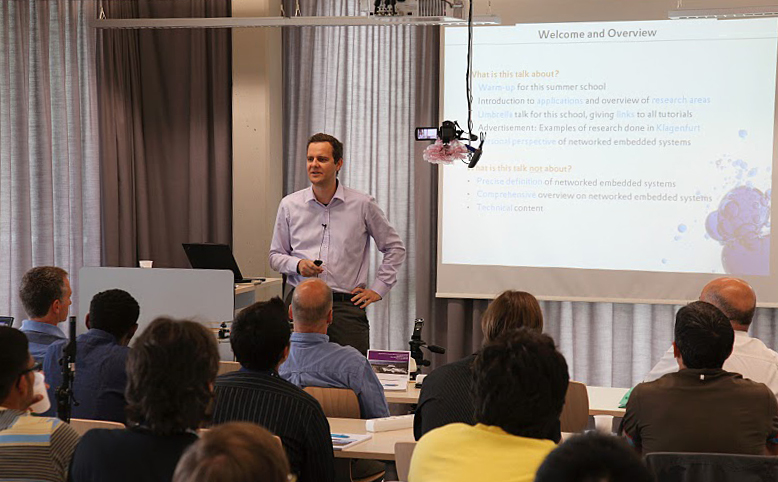
Christian Bettstetter giving a lecture
1. Introduction and Overview 
Volume: 1 lecture unit (2 hours)
- Applications of mobile technologies
- History and evolution of wireless communications
- Overview of current wireless technologies
- Key challenges in mobile and wireless systems
- Lecture overview, teaching philosophy, and literature
- Schedule winter
2. Antennas
Volume: 2 lecture unit
- Antenna examples and types
- Radio waves: Production of radio waves. Properties of radio waves. Energy transport, power density, and radiation intensity
- Antenna characteristics: Directivity and gain. Antenna patterns. Polarization
- Reception power (Friis equation)
Material
- Lecture video

- Additional videos
- Book: Balanis: Antenna Theory: Analysis and Design
3. Radio Propagation
Volume: 4 lecture units and project
- Path loss and shadowing:
- Propagation in free space
- Path loss models
- Shadow fading
- Multipath propagation:
- Small-scale fading models: Rayleigh, Rice, Nakagami fading and outage probabilities
- Time spread; frequency spread; time-variant behavior (fade rate, fade duration, Markov chain model); frequency-variant behavior; relationships
- Overview of fading mitigation techniques
Material
- Manuscript
- Group project: Path loss and shadowing
- Book: Schwartz: Mobile Wireless Communications
- Book: Goldsmith: Wireless Communications
4. Diversity
Lectures: 1 unit
- Ideas behind diversity und design space. Time diversity, frequency diversity, spatial diversity.
- Diversity combining schemes: Selection combining, maximum ratio combining; comparison; and outage probabilities.
- Diversity in practice
- Other diversity and multiple antenna techniques
Material
- Lecture video
- Book: Goldsmith: Wireless Communications
5. Channel Coding and Modulation
Volume: 4 lecture unit and project
a. Representation of signals
- Fourier series and transform
- Bandwidth
- Sampling and quantization
b. Channel coding
- Purpose of coding in wireless communications
- Block coding: Error detection and correction; Hamming code; CRC codes
- Convolutional coding: Encoding, Viterbi decoding,
- Coding gain
- Channel coding in practice
Material
- Lecture video
- Group project: Convolutional coding
- Book: Goldsmith: Wireless Communications
- Book: Schwartz: Mobile Wireless Communications
- Book: Molisch: Wireless Communications
- Dedicated books on channel coding mentioned in lecture slides
c. Modulation
- Purpose and types of modulation
- Linear digital modulation
- Coherent demodulation
- Modulation in practice
- Spead spectrum modulation
d. Duplexing
6. Multiple Access and Cellular Concept
Volume: 1.5 lecture units
- Purpose of multiple access
- Multiple access techniques: TDMA, FDMA, CDMA, and SDMA
- Cellular concept and channel reuse; SIR
- Orthogonal frequency division multiplexing (OFDM)
Material
- Group project: OFDM
- Book: Schwartz: Mobile Wireless Communications
- Book: Goldsmith: Wireless Communications
7. Medium Access Control (MAC) Protocols
Volume: 1.5 lecture units
- Purpose and classification of MAC protocols
- ALOHA and Slotted ALOHA
- Throughput analysis
- Carrier sense multiple access (CSMA)
- CSMA with collision avoidance (CSMA/CA)
- Quality of service support
- MAC protocols in practice
Material
- Book: Schwartz: Mobile Wireless Communications
- Book: Goldsmith: Wireless Communications
- Original publications on MAC mentioned in lecture slides
8. Wireless LAN
Volume: 1/2 lecture unit
- System and protocol architecture of WLANs
- Standardization of WLAN
- Evolution of the physical layer in IEEE 802.11
- Modulation and channel coding
- Operation in the unlicensed ISM band
- New developments and trends
Prelude to “Wireless Networks”
Volume: 1/2 lecture unit (1 hour)
- Introduction: Lecture overview and teaching philosophy
- Schedule summer
- Group projects summer
9. Network Architectures and Mobility Protocols
Volume: 3.5 lecture units and project
- Architecture and mobility in cellular networks
- General architecture
- Mobility types and mobility management
- System components from GSM to 5G
- Addressing
- Routing of calls to mobile users
- Routing of Internet packets mobile users
- Handover
- Mobility in the Internet
- Addressing and mobility problem
- Autoconfiguration
- Device mobility with Mobile IP
- Service mobility
Material
- Facts and figures: Cellular networks in Austria
- Lecture videos
10. 5G Networks and Beyond
Volume: 1 lecture unit
Previous years
- 5G and beyond: Technical aspects. Business relevance and regulatory framework (Guest lecture by experts from Deutsche Telekom, 2025).

- 5G and beyond (Guest lecture by Frank Fitzek, 2024).
11. Security in Mobile Networks
Volume: 1 lecture unit and project
- Basic threats and countermeasures
- Confidentiality
- Spoofing in networks
- Authentication in cellular networks
- Virtual private networks (group project)
- Wi-Fi security (group project)
12. Ad Hoc Networks
Volume: 3 lecture units and project
- Routing and relaying
- Connectivity and capacity
- Technologies and platforms: Bluetooth, Apple AirTags (group projects)
13. Impact: Economic, Health, and Societal Aspects
Volume: 2 lecture units
- What impact does mobility technology have on humanity?
- Economy: Subscriber numbers; industrial players; market characterization
- Health: Studies on potential carcinogenicity risks and other health concerns. 5G.
- Society: Cultural differences; digital divide and novel opportunities; pervasive computing