Swarmalator systems intertwine two forms of collective behavior—swarming and synchronization—leading to the emergence of space-time patterns. Our research advances both the foundations and application of swarmalators, with emphasis on the real-world challenges of deploying this concept in robots and drones.
Swarming and synchronization are two fascinating manifestations of collective behavior in nature. Swarming means that many entities act together as a coordinated group, like in bird flocks, fish schools, and insect swarms. Synchronization means that entities coordinate their internal rhythms in time, like in the synchronous flashing of fireflies or the collective beating of cardiac cells. Traditionally, these two phenomena have been studied as being independent from each other. But what would happen if we considered a joint model for swarming and synchronization? What if we coupled them in such a way that movement depends on synchrony and synchrony depends on movement?
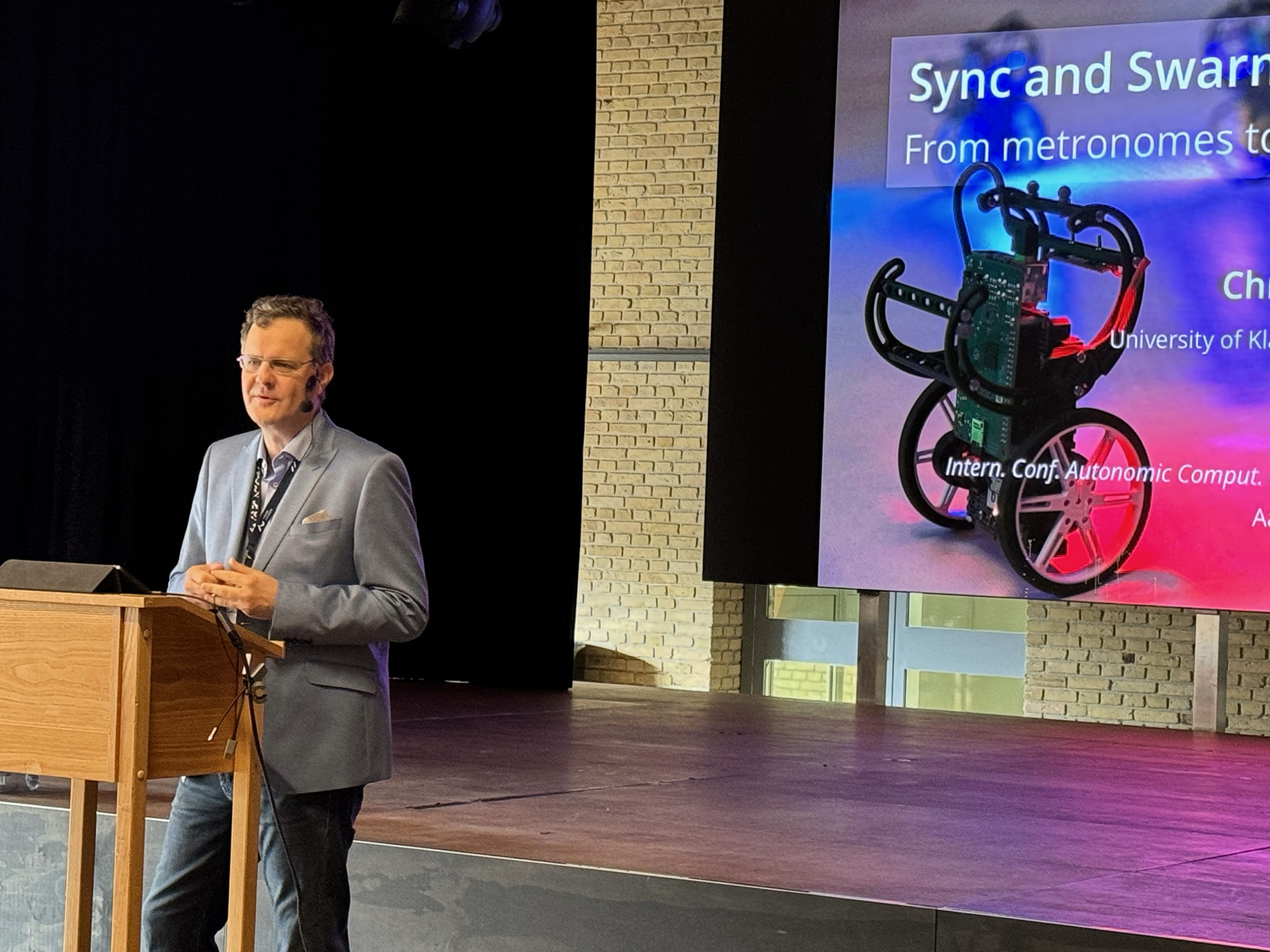
Keynote at IEEE ACSOS in Aarhus. Photo by L. Esterle.
This is exactly what swarmalators do. Each swarmalator adjusts its clock based on the clock values and positions of other swarmalators. And it performs movements based on both the positions and clock values of other swarmalators. The term swarmalator was introduced by O’Keeffe, Hong, and Strogatz in 2017, igniting a new line of research.
The concept is not just a theoretical construct but is relevant in the real world, like in microswimmers and magnetism, and holds great promise for applications in mobile robotics, where coordinated motion and timing are essential for adaptive and scalable behavior.
Research at Klagenfurt
Bettstetter and his team, together with collaborators, aim to advance both the theory and application of swarmalators by adapting the mathematical model for real robots and drones—addressing real-world challenges such as communication and movement constraints. The University of Klagenfurt was among the first, if not the first, to implement swarmalators in a physical robotic system and demonstrate swarmalators experimentally.
Their research directions include the following:
- Analyze and characterize emergent patterns in swarmalator systems
- Propose and assess extensions to the swarmalator model for practical applications
- Adapt and implement the swarmalator concept in mobile robotics including drones
Specifically, Bettstetter develops swarmalator systems that perform time-discrete coupling and local interactions, as required for technical applications, rather than the continuous, globally interactions assumed in the original model. A complementary line of research exploits the concept of randomized coupling in swarmalator systems to account for unreliable interactions or to reduce communication overhead.
Publications
- Elliptical patterns in swarmalator systems
IEEE Intern. Conf. on Autonomic Computing and Self-Organizing Systems (ACSOS), 2026 - Swarmalator networks with multihop coupling
Physical Review E, 2026 - Interplay of sync and swarm: Theory and application of swarmalators
Physics Reports, 2026 - Swarmalators with discrete-time coupling: Which step size to choose?
IEEE Intern. Conf. on Autonomic Computing and Self-Organizing Systems (ACSOS), 2025 - Multicircular static patterns in swarmalator systems: Radii and stability
Physical Review E, 2025 - Radii of emergent patterns in swarmalator systems
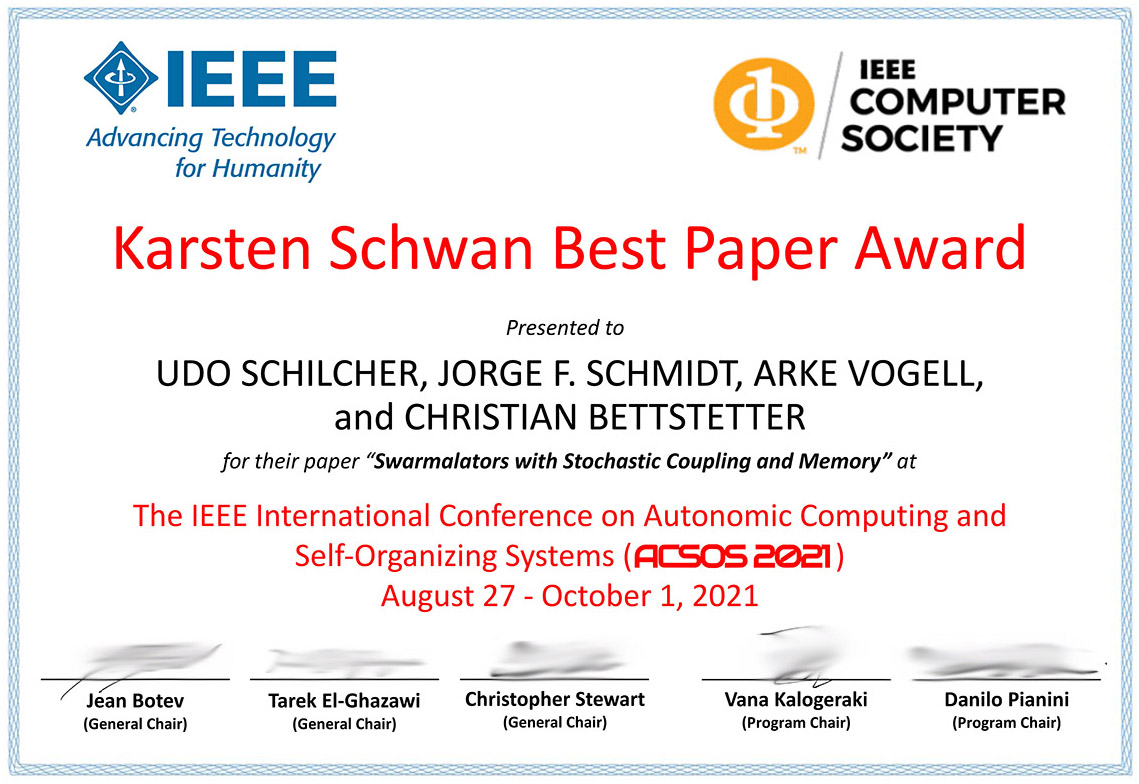
IEEE Intern. Conf. on Autonomic Computing and Self-Organizing Systems (ACSOS), 2023 - Swarmalators with stochastic coupling and memory (best paper award)
IEEE Intern. Conf. on Autonomic Computing and Self-Organizing Systems (ACSOS), 2021 - Sandsbots: Robots that sync and swarm
IEEE Access, 2020 - Robots that sync and swarm: A proof of concept in ROS 2
IEEE Intern. Symp. on Multi-Robot and Multi-Agent Systems (MRS), 2019 - A review of swarmalators and their potential in bio-inspired computing (invited paper)
SPIE Micro- and Nanotechnology Sensors, Systems, and Applications XI, 2019
Talks
- Sync and swarm: From metronomes to drones
Keynote at IEEE Intern. Conf. on Autonomic Comput. Self-Org. Syst. (ACSOS), Aarhus, Sept. 2024 - Swarmalatorbots: Robots that sync and swarm
Invited talk at Max Planck Institute for the Physics of Complex Systems, Dresden, June 2022 - Self-organizing synchronization: From metronomes to robot swarms
Invited talk at Trinity College Dublin, December 2018
Software
- Extended complexity explorable Swårmalätørs (2D and 3D)
Tutorial: What are swarmalators and their basic patterns?
This video by Christian Bettstetter explains the concept of swarmalators, discusses the five basic emergent patterns, and outlines applications in nature and technology (2024).
Podcast
This Podcast-style dialog introduces swarmalators and discusses the five basic patterns. It was created by Google’s NotebookLM based on the above video.
Robotic swarmalators
This video gives an insight into swarmalator robots, featuring interviews with Christian Bettstetter, Kevin O’Keeffe, and Udo Schilcher. They explain the basic principles of swarmalator systems and how we implemented them in our swarm robotics laboratory. The three researchers also state how robots communicate and coordinate their movements to form a variety of collective patterns (2026).
We implemented the swarmalator model on Sphero BOLT+ robots to demonstrate the five basic spatiotemporal patterns. Work by Marcus Schref and Arina Lukasheva. Video made with help of summer interns (2026).
This video shows our multi-robot system that forms emergent space-time patterns inspired by the theory of swarmalators, core part of the doctoral thesis of Agata Barcis as part of a Popper school (2020).
This work highlights a multi-drone system that performs a swarmalator system implemented on Crazyflies using the Crazyswarm platform (2019).
This work realizes and studies, for the first time, the concept of swarmalators in robotic systems (2018)
. . .